
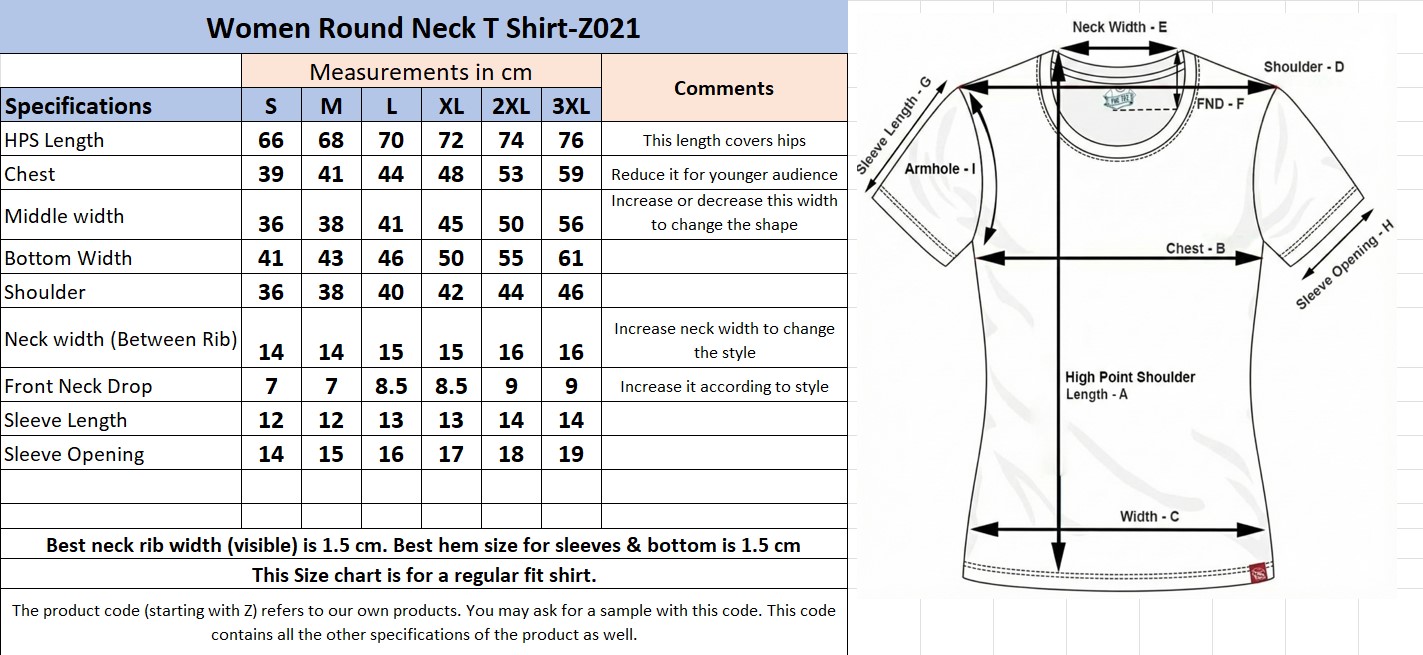
Women Round Neck T Shirt - Z021
| Specifications | Measurements (cm) | Comments | |||||
|---|---|---|---|---|---|---|---|
| S | M | L | XL | 2XL | 3XL | ||
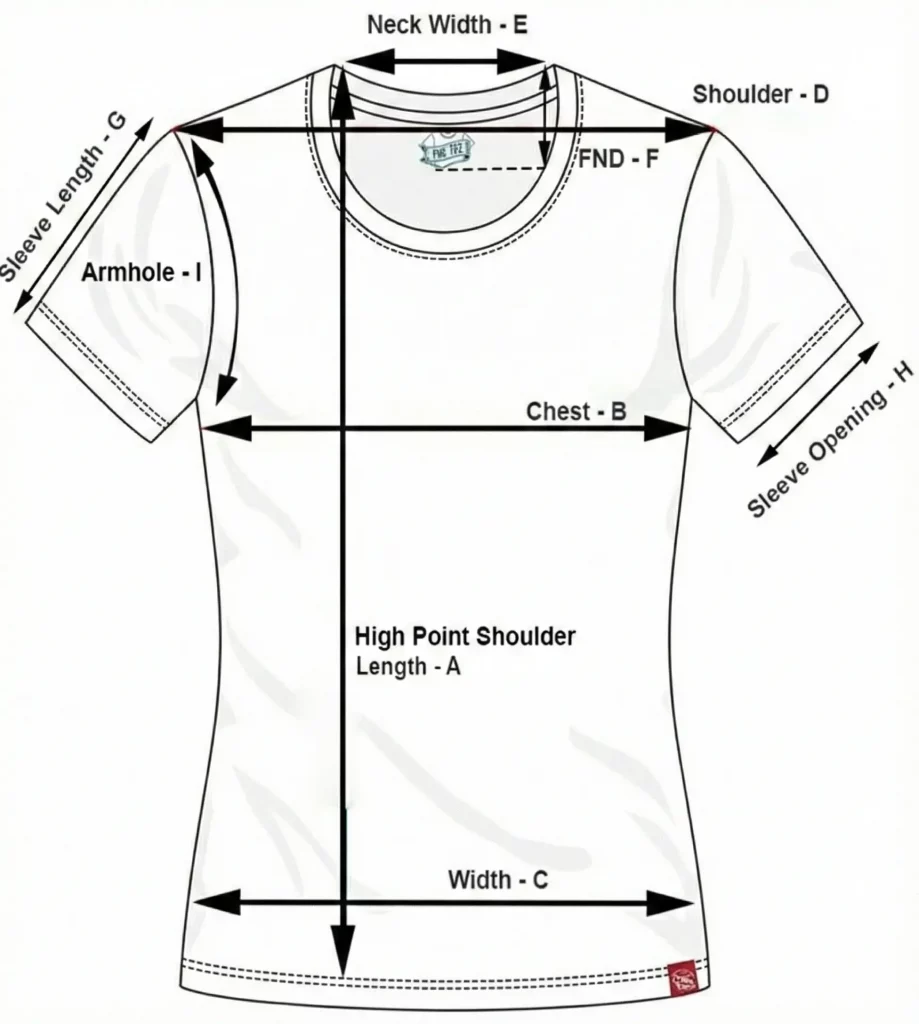
| A – HPS Length | 66 | 68 | 70 | 72 | 74 | 76 | This length covers hips |
| B – Chest | 39 | 41 | 44 | 48 | 53 | 59 | Reduce for younger audience |
| C – Middle Width | 36 | 38 | 41 | 45 | 50 | 56 | Increase or decrease this width to change the shape |
| D – Bottom Width | 41 | 43 | 46 | 50 | 55 | 61 | |
| E – Shoulder | 36 | 38 | 40 | 42 | 44 | 46 | |
| F – Neck Width (Between Rib) | 14 | 14 | 15 | 15 | 16 | 16 | Increase neck width to change the style |
| G – Front Neck Drop | 7 | 7 | 8.5 | 8.5 | 9 | 9 | Increase it according to style |
| H – Sleeve Length | 12 | 12 | 13 | 13 | 14 | 14 | |
| I – Sleeve Opening | 14 | 15 | 16 | 17 | 18 | 19 | |
| Best neck rib width (visible) is 1.5 cm. Best hem size for sleeves & bottom is 1.5 cm | |||||||
| This size chart is for a regular-fit shirt. | |||||||
| The product code (starting with Z) refers to our own products. You may ask for a sample with this code. This code contains all the other specifications of the product as well. | |||||||
Women's T-Shirt Size Chart
This chart maps standard size labels (XS through XXXL) to actual body measurements. Use this if you’re a shopper finding your size, or a brand defining a size range for your target customer.
| Size | Bust (in) | Bust (cm) | Waist (in) | Waist (cm) | Hip (in) | Hip (cm) | Length (in) | Length (cm) | Shoulder (in) | Shoulder (cm) |
| XS | 31-32 | 79-81 | 24-25 | 61-64 | 34-35 | 86-89 | 25.0 | 64 | 14.5 | 37 |
| S | 33-34 | 84-86 | 26-27 | 66-69 | 36-37 | 91-94 | 25.5 | 65 | 15.0 | 38 |
| M | 35-36 | 89-91 | 28-29 | 71-74 | 38-39 | 97-99 | 26.0 | 66 | 15.5 | 39 |
| L | 37-39 | 94-99 | 30-32 | 76-81 | 40-42 | 102-107 | 26.5 | 67 | 16.0 | 41 |
| XL | 40-42 | 102-107 | 33-35 | 84-89 | 43-45 | 109-114 | 27.0 | 69 | 16.5 | 42 |
| XXL | 43-45 | 109-114 | 36-38 | 91-97 | 46-48 | 117-122 | 27.5 | 70 | 17.0 | 43 |
| XXXL | 46-48 | 117-122 | 39-41 | 99-104 | 49-51 | 124-130 | 28.0 | 71 | 17.5 | 44 |
| Each size is shown as a range because most ready-to-wear t-shirts are designed with a few inches of ease built in beyond your exact bust measurement. If your measurements fall between two sizes, the fit-type section below will help you decide whether to round up or down. | ||||||||||
Women's Round Neck T-Shirt — Flat Measurement Chart (Style Z021)
This chart shows actual finished garment dimensions, measured flat, as used in factory tech packs. It reflects a regular-fit, round-neck women’s t-shirt (style code Z021).
| Specification | XS (in / cm) | S (in / cm) | M (in / cm) | L (in / cm) | XL (in / cm) | XXL (in / cm) | XXXL (in / cm) |
| A – HPS Length | 25.2 / 64 | 26.0 / 66 | 26.8 / 68 | 27.6 / 70 | 28.3 / 72 | 29.1 / 74 | 29.9 / 76 |
| B – Chest Width | 14.6 / 37 | 15.4 / 39 | 16.1 / 41 | 17.3 / 44 | 18.9 / 48 | 20.9 / 53 | 23.2 / 59 |
| C – Middle Width | 13.4 / 34 | 14.2 / 36 | 15.0 / 38 | 16.1 / 41 | 17.7 / 45 | 19.7 / 50 | 22.0 / 56 |
| D – Bottom Width | 15.4 / 39 | 16.1 / 41 | 16.9 / 43 | 18.1 / 46 | 19.7 / 50 | 21.7 / 55 | 24.0 / 61 |
| E – Shoulder | 13.4 / 34 | 14.2 / 36 | 15.0 / 38 | 15.7 / 40 | 16.5 / 42 | 17.3 / 44 | 18.1 / 46 |
| F – Neck Width (between rib) | 5.3 / 13.5 | 5.5 / 14 | 5.5 / 14 | 5.9 / 15 | 5.9 / 15 | 6.3 / 16 | 6.3 / 16 |
| G – Front Neck Drop | 2.6 / 6.5 | 2.8 / 7 | 2.8 / 7 | 3.3 / 8.5 | 3.3 / 8.5 | 3.5 / 9 | 3.5 / 9 |
| H – Sleeve Length | 4.5 / 11.5 | 4.7 / 12 | 4.7 / 12 | 5.1 / 13 | 5.1 / 13 | 5.5 / 14 | 5.5 / 14 |
| I – Sleeve Opening | 5.1 / 13 | 5.5 / 14 | 5.9 / 15 | 6.3 / 16 | 6.7 / 17 | 7.1 / 18 | 7.5 / 19 |
Understanding tech-pack terms: HPS stands for “High Point Shoulder” — the highest point of the shoulder seam near the collar, used as the starting point for measuring overall length. Chest Width and Middle Width are measured flat, side seam to side seam — multiply by two to estimate body circumference. The recommended neck rib width is 1.5 cm, and the recommended hem allowance for sleeves and bottom is also 1.5 cm. This chart represents a regular fit; the “Middle Width” can be adjusted to produce a slimmer or more relaxed silhouette. This style is referenced as Z021 — quoting this code when requesting a sample lets our team pull up the complete specification sheet without needing further explanation.
International Size Conversion Chart (US, UK, EU, AU)
Women’s clothing sizes are labeled differently depending on the country. The table below gives approximate conversions between the size labels most commonly seen in the US, UK, European Union, and Australia.
| Letter Size | US Size | UK Size | EU Size | AU Size | Bust (in) |
| XS | 0-2 | 4-6 | 32-34 | 4-6 | 31-32 |
| S | 4-6 | 8-10 | 36-38 | 8-10 | 33-34 |
| M | 8-10 | 12-14 | 40-42 | 12-14 | 35-36 |
| L | 12-14 | 16-18 | 44-46 | 16-18 | 37-39 |
| XL | 16-18 | 20-22 | 48-50 | 20-22 | 40-42 |
| XXL | 20-22 | 24-26 | 52-54 | 24-26 | 43-45 |
| XXXL | 24-26 | 28-30 | 56-58 | 28-30 | 46-48 |
As a quick rule of thumb: a US size is roughly four sizes smaller than the equivalent UK number, and roughly 32 smaller than the equivalent EU number (e.g. US 8 ≈ UK 12 ≈ EU 40). Australian sizing generally tracks closely with UK sizing. These are approximate mappings — actual sizing varies by brand, so the body-measurement chart above is the most reliable reference regardless of which country’s label is on the tag.
Note on Asian market sizing: Many Asian size charts tend to run smaller in absolute body measurements than US or European charts for the same letter size — often by one to one-and-a-half inches across the bust and shoulder. If manufacturing for a global audience, request a custom grading table from your manufacturer rather than assuming a single international standard applies to all markets.
How to Measure Yourself Correctly
Accurate self-measurement is the most reliable way to find your correct t-shirt size. Use a flexible fabric tape measure and stand naturally. Measure over light clothing similar to what you’d wear under the t-shirt.
Bust
Wrap the tape around the fullest part of your bust, keeping it level and parallel to the floor. The tape should sit snugly but not compress your chest.
Waist
Measure around your natural waistline — the narrowest part of your torso, usually just above your belly button. Keep the tape horizontal and comfortable against your skin.
Hip
Stand with feet together and measure around the widest part of your hips and buttocks, keeping the tape level. This is usually 7–9 inches (18–23 cm) below your natural waistline.
Shoulder Width
Measure across the back from the edge of one shoulder bone to the edge of the other, keeping the tape flat and level across the back of the neck and shoulders.
Garment Length
Measure from the highest point of the shoulder seam (the HPS, near the collar) straight down to the bottom hem, with the garment laid flat. Compare this to the “Length” row in the body-measurement chart to estimate where the hem will fall on your body.
Women's T-Shirt Fit Types
“Size” tells you garment dimensions; “fit” tells you how those dimensions relate to your body. Here are the five most common women’s t-shirt fits.
Slim Fit
Cut close to the body through the chest, waist, and arms with minimal ease. Creates a tailored, streamlined silhouette suited to layering or a polished look.
Regular Fit
The industry default and the basis for the size charts on this page. Follows the natural body line with a few inches of ease for comfortable movement — not tight, not loose. The most common fit for basic bulk-production t-shirts.
Relaxed Fit
Adds noticeably more room than regular fit without going fully oversized. A comfortable, easy-wear option popular for everyday casual wear and softer, less structured silhouettes.
Oversized Fit
Deliberately cut larger than the wearer’s actual measurements across the chest, shoulders, and length, often with dropped shoulder seams. Creates the boxy, draped silhouette associated with streetwear and casual fashion. Finished measurements will be significantly larger than body measurements — sometimes by one full size or more.
Athletic Fit
Cut with extra room through the shoulders and chest while tapering at the waist, often using moisture-wicking performance fabrics. Popular for activewear and gym-focused product lines.
Fabric Shrinkage Guide: How Material Affects Sizing
Fabric choice can change a t-shirt’s finished size by several percentage points after washing. Here’s what to expect from the most common t-shirt fabrics.
Expected Shrinkage by Fabric Type (After Washing)
Pure cotton is breathable and soft but most prone to shrinkage, particularly after the first one or two hot-water washes — especially if the fabric hasn’t been pre-shrunk (also called “compacted” or “sanforized”). Cotton-polyester blends significantly reduce shrinkage while retaining much of cotton’s softness, making them a popular choice for brands that want predictable sizing across production runs. Polyester holds its shape extremely well (under 1% shrinkage) and is standard for performance garments. Tri-blends offer soft, lightweight drape with moderate shrinkage comparable to cotton-poly blends.
| Fabric | Typical Shrinkage | Sizing Recommendation |
| 100% Cotton (untreated) | 3-5% | Consider sizing up or requesting pre-shrunk/compacted fabric |
| Organic Cotton | 3-6% | Similar to conventional cotton; check if pre-shrinking has been applied |
| Cotton-Polyester Blend | 1-3% | More dimensionally stable; suitable for true-to-size fits |
| 100% Polyester | Less than 1% | Highly stable; good for performance and athletic-fit garments |
| Tri-Blend (Cotton/Poly/Rayon) | 1-3% | Generally stable, but verify the rayon component is pre-treated |
Manufacturing Women's T-Shirts: What Brands Should Know
Zephyrs Textile manufactures women’s t-shirts and knit garments for brands, retailers, and distributors worldwide, supporting everything from standard bulk orders to fully custom private-label programs.
Bulk Production & MOQs
Bulk production runs are priced and planned around a minimum order quantity (MOQ), which varies depending on fabric type, number of colors, and number of sizes in your order. As a manufacturer, we cannot produce or sell below our minimum order quantities — brands planning smaller test runs should factor this into their sourcing timeline and budget.

OEM Manufacturing
OEM (Original Equipment Manufacturing) means producing t-shirts to a brand’s existing specifications — fabric, fit, sizing, trims, and labeling are all defined by the brand, and the factory executes production to that specification. This is a common starting point for brands that already have a developed tech pack.
Private Label Manufacturing
Private label manufacturing goes a step further: the factory may help develop the product itself — fabric selection, fit development, sizing, and sample iteration — which the brand then sells under its own label. This route suits brands that have a concept and target market in mind but don’t yet have a finalized tech pack.
Custom Size Sets & Grading
Brands targeting a specific regional market or body-type focus (for example, a petite-only or size-inclusive range beyond XXXL) can request custom grading adjusted to match their target customer rather than a generic standard.
International Export & Compliance
Production is prepared for international shipping with attention to labeling, packaging, and documentation requirements. Brands should communicate any compliance, labeling, or testing requirements for their target country early in the development process.
Frequently Asked Questions
1. What is the most common women’s t-shirt size?
Globally, Medium is the most commonly stocked and purchased women’s t-shirt size, corresponding to roughly a US 8–10, UK 12–14, or EU 40–42, with a bust measurement of about 35–36 inches (89–91 cm).
2. How do I find my correct women’s t-shirt size?
Measure your bust, waist, and hips with a soft tape measure, then compare those numbers to the body measurement chart above rather than relying on your usual clothing size, since t-shirt sizing varies between brands and regions.
3. Should I size up for 100% cotton t-shirts?
It can help to size up slightly or choose pre-shrunk fabric, since untreated cotton typically shrinks about 3–5% after the first few washes, which can noticeably affect fit.
4. How do US, UK, and EU women’s sizes compare?
As a general rule, a US size is roughly four sizes smaller than the equivalent UK number and about 32 smaller than the equivalent EU number — for example, a US size 8 is approximately a UK size 12 and an EU size 40, though exact conversions vary by brand.
5. Can I order custom size sets for my private label brand?
Yes, Zephyrs Textile can develop custom size sets and grading rules tailored to a brand’s target market, provided the order meets our minimum order quantity.
6. What is the typical MOQ for custom t-shirt manufacturing?
MOQs vary depending on fabric type, printing method, and the number of colors or sizes requested. Contact us directly with your specifications for an accurate MOQ.
7. What information should I send to get a t-shirt quote?
Provide the desired fabric composition and GSM, fit type, size range and quantity breakdown per size, printing or embellishment details, and any custom measurement specifications or tech packs you have prepared.
8. What is HPS in a t-shirt size chart?
HPS stands for High Point Shoulder — the highest point of the shoulder seam near the neckline, used as the standard starting point for measuring overall garment length in manufacturing tech packs.